
One thing having a six year old has taught me is that I really don’t know very much. When my oldest daughter was four, there wasn’t a question she could throw at me that I didn’t at least have some answer to, even if I took a few liberties here and there. Even when she hit five I was still able to make a good showing. When she turned six she began to expose the weaknesses in my foundation, the scratches my veneer.
Through a daily rhythm of call and response during our morning commute, I began to realize the extent of my ignorance. I read quite a bit and think of myself as a relatively well informed person, but as I get older and my kids get wiser I’ve become very aware of how lame I am. Some of my knowledge blind spots are pretty funny; others are surprising; still others are probably not too far off from you, if you’re secure enough to admit it.
So please pour a glass of your favorite beverage so we can toast our lack of knowledge together. If you find yourself interested in the stuff I clearly didn’t know when I sat down to write this, please check out all the footnotes. I’ve researched every point in this piece and have provided the right answers for you.
What don’t you know? Here is what I don’t know.
My oldest daughter asked me the other day how a plane stays in the air. We’re a bit south of San Francisco International Airport and directly under most flight paths, so we are quite used to seeing jets overhead. I typically pay them no heed but this particular morning I paused to look up as she asked, making sure not to lose grip of the squirming boy I was shoehorning into a car seat. The truth is, I’m as dumbfounded as she is they don’t just fall out of the sky every time I look at them. In fact, I don’t think I’d be more amazed if I lived in the middle ages and saw the Blue Angels fly by in formation. I told her it has something to do with air pressure under and over the wing, then I trailed off mumbling as I snapped Liam in, clearly without his consent. She seemed completely and deservedly underwhelmed by her Dad’s knowledge of human engineered flight. I even read David McCullough’s The Wright Brothers and that’s all I got.1I was actually off to a good start with the answer to my daughter’s question but couldn’t close the deal. A plane flies because an engine pushes the plane rapidly forward, which forces air to flow both above and below the wings. Those wings, in two different ways, give the plane lift so it can rise above the ground. The first way the wings lift a plane is their angle of attack, or the angle they are situated at in relation to the ground. More specifically, the leading edge of airplane wings are a bit higher than the lagging edge. This pushes air downward behind the plane, allowing it to lift.
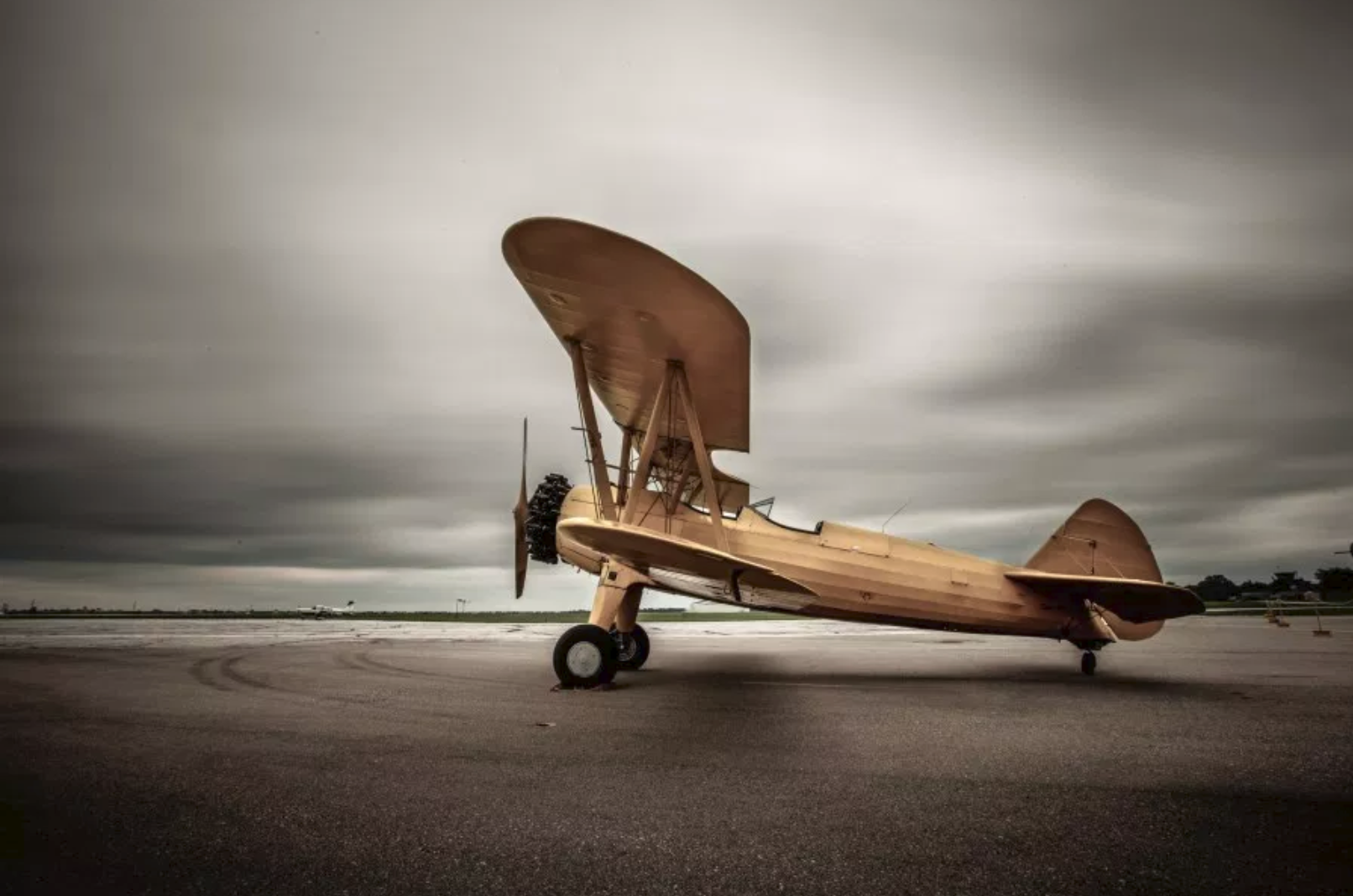
The other way a modern plane lifts off the ground is due to the shape of the wings. They have an airfoil shape, which means the top of the wing is curved. When air is forced over and under the wing, the air on top travels over the wing with lower pressure than the air going under the wing. Why? Because the curved top means the air molecules have to travel over a greater area (the same number of molecules over a larger area equates to lower pressure because there is far more room for those molecules to move around). Lower pressure on top of the wing versus the higher pressure on the bottom lifts the plane into the air.

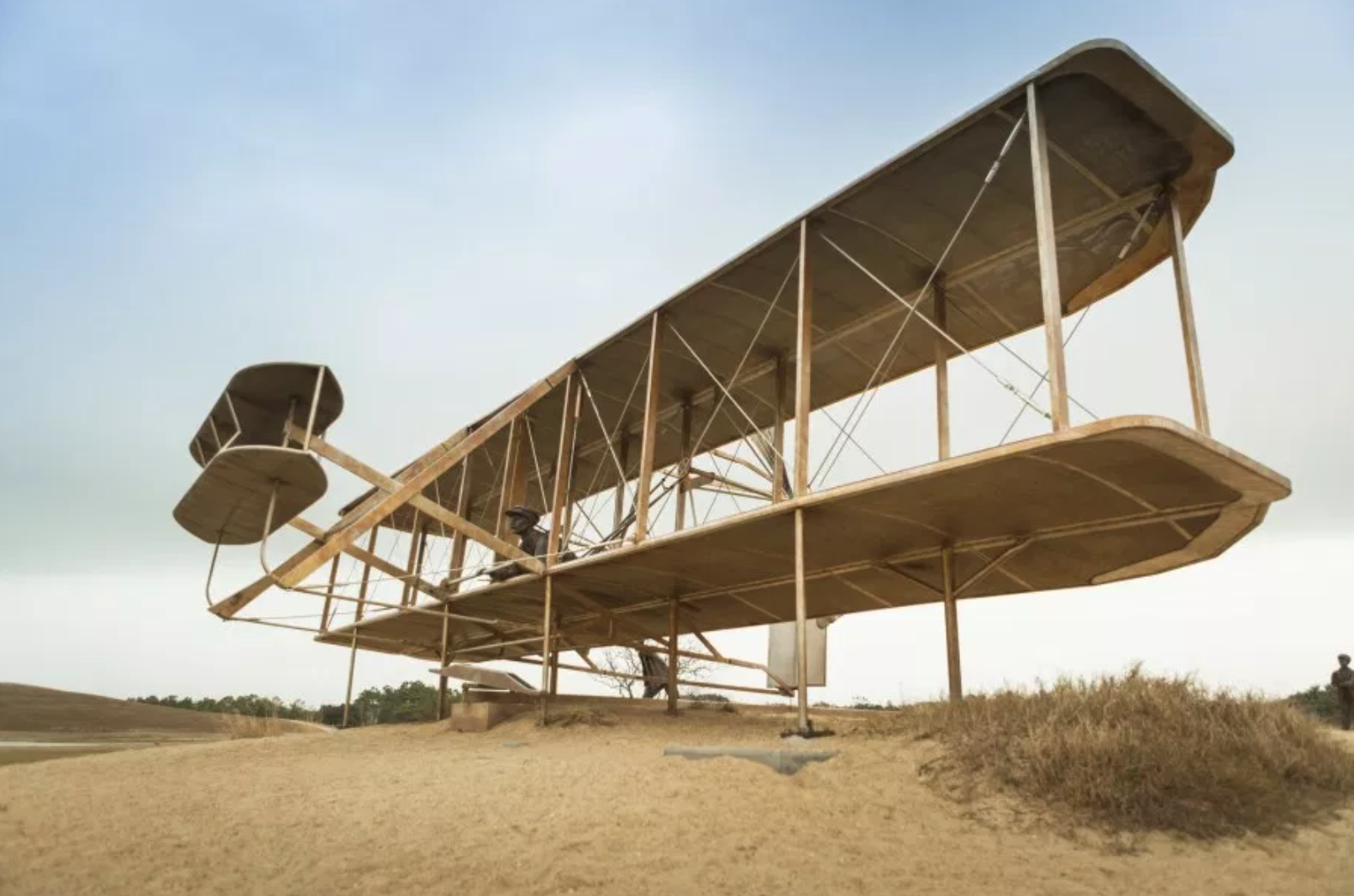
Wright Brothers National Memorial – Kitty Hawk, North Carolina
Some time back my youngest daughter asked me what a mammal was. I told her with confidence that mammals had hair and were warm blooded. Then she asked me what warm blooded meant. I naturally answered that their blood was much warmer than…well, than cold blooded critters. I satisfied her and to some degree myself, even as I felt a nagging need to look this stuff up as soon as we got to her school. Twelve minutes later I completely lost track of the enlightening science knowledge I had passed on, opting instead to see how Brooks Koepka was faring in his second round. Nine hours, seven meetings, and 47 emails after that, my daughter informed me that whales were mammals so I had to be wrong about the hair thing. And warm blooded just means an animal’s temperature stays mostly the same all the time. She finished with, “Let’s just ask Google next time, ‘kay Dada?” Ouch. I actually wonder at this point why she keeps coming to me, as if I’ve proven myself to be a fount of wisdom. Every time she corrects me she looks at me like it’s my fault. I just shrug my shoulders and remind her who’s asking who in this equation.2According to Brittanica.com, mammals are unique in these ways:
– They nourish their young with milk
– They typically have hair (except with adult whales)
– Their lower jaw attaches directly to their skull, not to a separate bone
– They have a muscular diaphragm that separates their heart and lungs from their abdominal cavity
– Their mature red blood cells have no nucleus
– Virtually all of them bear live young without eggs
– They can regulate their body temperature in extreme heat and cold (commonly known as “warm blooded” but scientifically called endothermy). See this Wikipedia entry for more information on thermoregulation.
I think I know the basics about the human body, but I surprise myself with just how remedial my basics are. For instance, I don’t know what a spleen is for but I don’t think you really need it. I know you can rupture it, but it seems like maybe that’s all you can do because I’ve never heard of anyone doing anything else to it. Also, a few years ago I looked up where my appendix was when I had a stomach ache. I was disappointed when I learned it’s not a separate organ; it’s just a little compartment hanging off your intestines. All this time I’d thought it was some softball sized, squishy organ floating around down there, hanging out with my kidneys. On that note, I still can’t tell you which side of my gut it calls home.3Your appendix is located in your lower right abdomen.
Your spleen serves several functions:
– It filters your blood, which in the spleen’s case means it affects the number of oxygen-carrying red blood cells and clot-forming platelets you have in your body. It does this by removing old, abnormal, or damaged cells.
– It stores red blood cells, platelets, and white blood cells.
– It produces white blood cells when your body detects invaders like bacteria or viruses.
I was right that a spleen can rupture, but it can also enlarge prior to any rupture due to a variety of different reasons:
– Bacterial, viral, and parasitic infections
– Certain types of cancers
– Liver diseases

I was also correct that you don’t absolutely need your spleen. The liver and your lymph nodes will take over many of its tasks, but you do have a higher likelihood of infection without it and it may take longer to recover.
I found all these details at this entry on Healthline.com.

I don’t get meteorology. Everyone understands that it will be 68 degrees and overcast. I’m good so far. But when they start talking pressures, fronts, and polar vortexes…well, I just sort of tune out. The weather person always seems so excited by precipitation records and dramatic changes in pressure. Living in California and working in Silicon Valley, the weather is nice-to-have information rather than a critical dependency to my day. I’ll be wearing my tech worker uniform no matter what Steve Paulson says: jeans, a casual shirt, and – maybe three months of the year – a light rain jacket. So I usually just glaze over and wait for the temps and little icons.
The other day my youngest daughter, right in the middle of a unit at school on insects, posed another great one to me: “When do bees sleep?” My first thought was actually another question: “Uh…bees sleep?” Does that also mean spiders, ladybugs, and flies sleep too? I have trouble picturing an insect sleeping. And I think with bees, don’t they only live a few weeks? (Admission: my “knowledge” on this point, embarrassingly, comes from Jerry Seinfeld’s Bee Movie where there’s a joke about bees having an incredibly short life span). If this is true, maybe they don’t actually sleep at all. Maybe their life is one big bender, just stoned and partying on honey the whole time. It would possibly explain that unfairly abbreviated stay on earth. If they do sleep, I have absolutely no idea if it’s aligned with day or night.4“Similar to our circadian rhythm, honeybees sleep between five and eight hours a day. And, in the case of forager bees, this occurs in day-night cycles, with more rest at night when darkness prevents their excursions for pollen and nectar (Source).”
And according to Buzz About Bees.net, bees live different lifespans depending on their role and when they are born. With honey bees, workers raised in the spring or summer may live only six or seven weeks. Workers raised in the autumn may live four to six months because they have much less to do and get far more rest. Drones may live up to four months, but if they mate with the queen they die immediately (total bummer). Queen bees can live three or four years if they are healthy.
As to whether spiders, flies, and ladybugs sleep, the answers seem to be yes, yes, and yes:
– Spiders
– Flies
– Ladybugs

I can name by sight only a handful of flowers, plants, and trees. I would have been such a loser amongst nineteenth century men of letters, passing their days drawing leaves in their journals with Da Vinci-like precision. I know roses, orchids, and daffodils, and I think I can spot a tulip. Redwoods and Oaks too. Oh, and Palm trees. Those are all pretty obvious. But then I slow down really fast. A couple of years ago we landscaped our yard and had an assortment of plants and flowers put in. Some kind friends showed interest in our garden and asked about several varieties. All I could do is shrug my shoulders. No clue. Occasionally we’ll go hiking and my wife will say, “Oh look, a Goldfinch. See it? In the spruce.” I’ll just look vaguely up and grunt agreement rather than admit, for the thousandth time, that I can’t distinguish a Goldfinch from any other yellow bird and I don’t know what the fuck a spruce tree looks like in any season.5I am so totally bored by this, but just to be thorough here I looked up spruce trees and did some research (lucky you!). When I was writing this and coming up with a random tree name to use, I had pictured a spruce as a pine tree. I was close in that they look somewhat similar, but a pine tree is in fact a different type of tree. The biggest difference appears to be that on pine trees the needles grow in little clusters of two, three, or five needles, whereas on spruce trees the needles grow directly from the stem one by one (no clusters at all…who would have thought??). Their cones and the shape of the needles also differ. If you so desire, you can read up on these fascinating differences here.

I can’t solve this problem: “A passenger train leaves the train depot two hours after a freight train left the same depot. The freight train is traveling 20 mph slower than the passenger train. Find the rate of each train, if the passenger train overtakes the freight train in three hours.” I can hear you scoffing and barking at your phone right now, telling me I just need to know the simple formula Rate X Time = Distance and plug in the numbers. Well, I’m living proof some of us need more than that. I know E = mc2 is a badass formula that has something to do with the space time continuum and the speed of light, but I have no idea how to plug anything into it to make it comprehensible. If he was alive I think Einstein might wonder how I’m still in the gene pool. Note to my daughters: seek tutors from fourth grade on because Daddy does math like he puts on your makeup.6I won’t try to explain the solution to this problem because, as I made clear, no one wants me teaching math. So I’ll let you read the answer yourself at Purplemath.com.
Regarding E=mc2:
> E = energy
> m = mass
> c2 = the speed of light, squared
According to Dictionary.com’s entry for this formula, “because the speed of light is a very large number and is multiplied by itself, this equation points out how a small amount of matter can release a huge amount of energy, as in a nuclear reaction.”

My first college class ever was calculus. I lasted for one half of one class. The morning of that first ever class, I woke up to find my bike (my only mode of transportation) had a flat tire. And because I had gotten drunk the night before celebrating my new found collegiate freedom, I hadn’t bothered to scout out my class location. I walked to school and roamed around until I found my class, strolling in 45 minutes late to a 250-person auditorium in the middle of lecture. The professor stopped his talk dead when I walked in and, after a dramatic pause to allow every head to turn, said in the most condescending tone he could conjure up, “How nice of you to join us.” Naturally, the only seat available was in row one, front and center. I can still feel the eyes on me as I made my way down in the stone cold silence. The professor calmly waited, pausing his lecture to make his point while I worked my way into the center of the aisle. The greatest fact about all of this is I was taking it as an elective. I thought, hey, even though trigonometry is where my math brain completely ran out of steam, why not try calculus? That sounds fun. I went home and dropped the class that afternoon. So the next time you need to measure the area under a curve (or whatever else calculus does for us), don’t ask Siri to dial JEE-NEE-O BORG-HYE.7According to Google Dictionary, calculus is “the branch of mathematics that deals with the finding and properties of derivatives and integrals of functions, by methods originally based on the summation of infinitesimal differences. The two main types are differential calculus and integral calculus.” You don’t say? That really clears it up for me.
Let’s go at this another way. It just so happens that my niece Olivia is working on her PhD in pure mathematics. Here is her explanation from a Facebook messenger conversation we had: “Calculus is the study of the pace at which change occurs. So like if you’re moving, your position is changing over time. If we measure the pace at which it is changing we call that velocity. So the derivative with respect to time of position is velocity. In the same fashion, if your velocity is changing over time, you would say acceleration is its derivative. It turns out that if you’re trying to do the opposite thing like find position given a speed function or velocity given an acceleration function, that it has a really visual interpretation. Like if I plot a line on an axis showing its speed over time. Then the position can be given by the area of the shape the line makes above the axis.”
My conclusion on this point is there are some things I’m not meant to understand.

The Rock of Gibraltar
I can’t tell you if Ohio touches Illinois, what continent the Danube River runs through, or from which land masses the Andaman Sea takes her shape. I can’t tell you where the Strait of Gibraltar cuts its path, though I think there’s a pretty big rock marking the spot. I can name maybe four Canadian provinces but I think there are at least seven. I’ve actually been to India three times and I still can’t remember if Bangalore is in the north or south. I can, however, tell you with precision the location of every Starbucks within about a ten mile radius of my home, complete with recommendations on which ones offer the quietest little nooks to do the occasional conference call from.8Ohio does not touch Illinois at all. The entire state of Indiana is in between them. My sincerest apologies to all the Hoosiers out there.

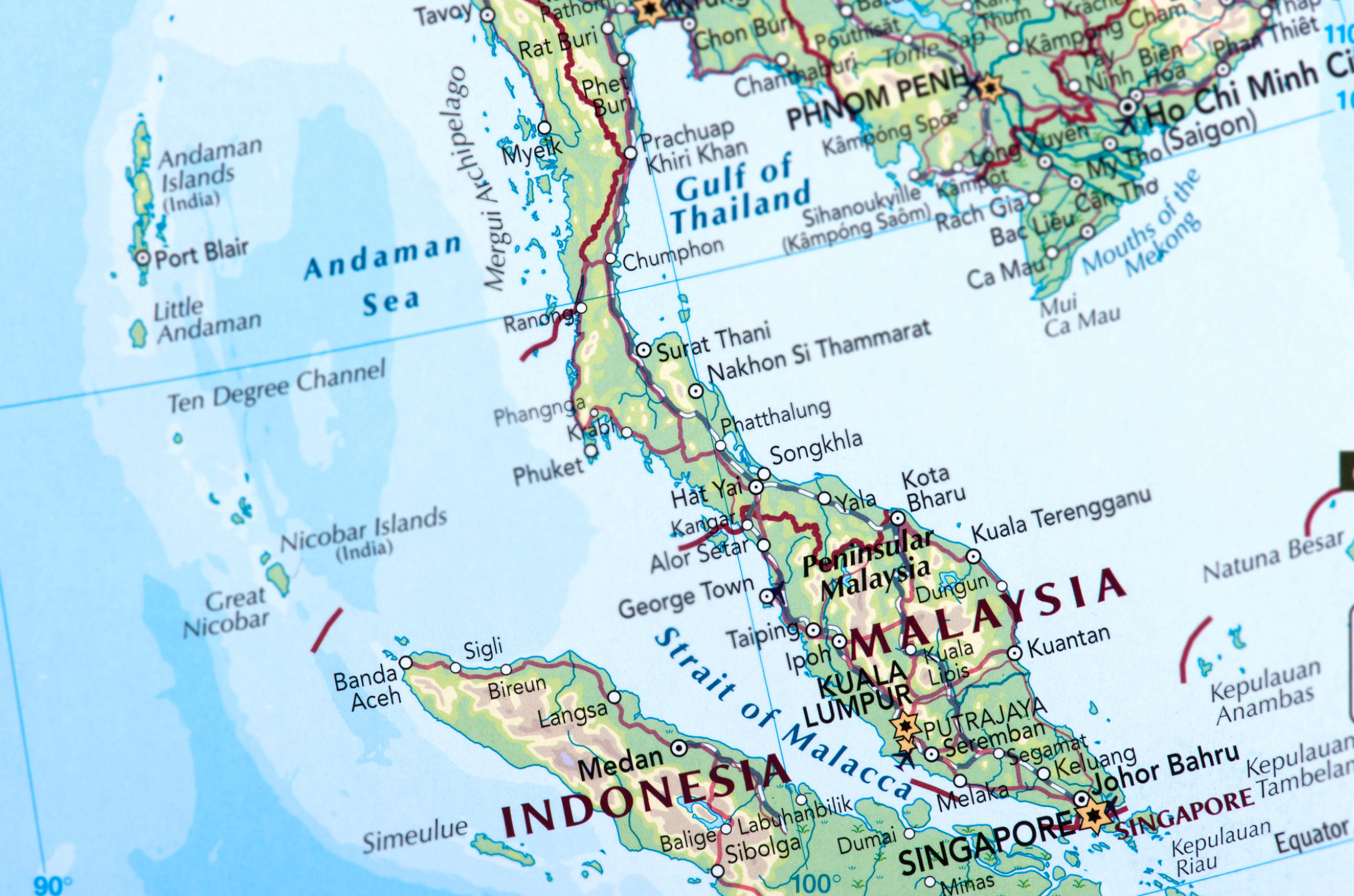
9The Danube River is wholly in Europe10The Andaman Sea touches the Andaman and Nicobar Islands (part of India) to its West; Myanmar to its North and Northeast; Thailand to its East; West Malaysia to its Southeast; and Breueh Island to its South (part of Indonesia).
11According to Wikipedia, the Strait of Gibraltar is “a narrow strait that connects the Atlantic Ocean to the Mediterranean Sea and separates Gibraltar and Peninsular Spain in Europe from Morocco and Ceuta (Spain) in Africa.” Gibraltar itself is a British territory on Spain’s South coast. The Rock of Gibraltar does indeed mark the spot, at least partially. It is located on the Eastern side of Gibraltar, facing the Mediterranean Sea.12Canada has 10 provinces and three territories. They are lumped together in most discussions, but they are actually different. Provinces get their power and authority from a major part of the Canadian constitution called the Constitution Act, 1867. Territories have power given to them by the Canadian parliament. Any change to the power structure of the provinces would require a constitutional amendment, whereas a similar change to the territories would just require an act by Canadian parliament. The 10 provinces are Alberta, British Columbia, Manitoba, New Brunswick, Newfoundland and Labrador, Nova Scotia, Ontario, Prince Edward Island, Quebec, and Saskatchewan. The three territories are Northwest Territories, Nunavut, and Yukon.
 13Bangalore is in Southern India and is the capital of the Indian state of Karnataka.

14I prefer to work in my office, rather than remotely. But over the years I’ve done countless calls from weird locations, usually because of some appointment for my kids that I’m dashing to as I worm my way through the jigsaw puzzle of my daily schedule. Some calls are simply not amenable to being away from your laptop. Others – like all hands meetings, certain trainings, and status calls that require quick updates from lots of people – can work reasonably well if you play it right.
Here are my top three peninsula Starbucks locations from which to do these types of conference calls:
– 3590 Alameda de las Pulgas, Menlo Park: With most Starbucks outdoor seating you will deal with lots of heavy traffic sounds. And although this one is on Alameda de las Pulgas, I’ve had pretty good luck taking calls on the patio or in the seats alongside Avy Avenue. For some reason the traffic is not quite as loud here as in other locations.
– 325 Sharon Park Drive, Palo Alto: Again, the outdoor patio here is nice because it’s next to a parking lot rather than a busy street. The downside is it’s very crowded and a popular stop for Silicon Valley execs. So make sure you’re not talking about or viewing sensitive information. If you’re mostly listening, it’s a great place to sip your latte and do a casual call.
– 2227 Broadway Street, Redwood City: Once again I’m going to recommend the outdoor seating for a call. The street can get a little louder here, but the lack of crowd outside makes it worthwhile. The additional plus for coffee aficionados is that this Starbucks is a reserve location. So if you like your coffee made with complex chemistry equipment, this is the place for you.
I’ve heard the term the dawn of man. But when was that? When did we really start? I won’t say I have no idea, because I think I can ballpark it. I know, courtesy of the Jurassic Park movies, that dinosaurs walked the earth – and were annihilated – about 65 million years ago. And even though Land of the Lost would have me believe man chilled with dinosaurs, I know that didn’t happen. So I have us transitioning from cavemen sometime between 65 million and like maybe 50,000 years ago. Why 50,000? Because I’ve read some ancient history to about three thousand B.C. so we at least had to be homo sapien (?) for some time before that. And since 50,000 years constitutes some (as in, barely any) time on the evolutionary wristwatch, I’m going with that. Final answer.15There is no simple answer to when we became who we are today. Human evolution is a spectrum with various milestones, including transitioning to bipedalism (upright walking), the doubling of our cranial capacity (called encephalization), and the use of tools. Nailing down one in particular is extremely difficult.
That being said, I am going to pat myself on the back for my estimate of 50,000 years ago being our start. Why? Check out this little tidbit from this exhaustive Wikipedia entry on human evolution: “According to the recent African origin of modern humans theory, modern humans evolved in Africa…and migrated out of the continent some 50,000 to 100,000 [bold is mine] years ago, gradually replacing local populations of Homo erectus…” Not too shabby for a wild ass guess, huh?

I get so confused by military terms. Most evenings this past month, after dinner and stories, tantrums and hugs, and final back scratches that send my daughters off to dreamland, I’ve been making my way through Ken Burns’ and Lynn Novick’s amazing documentary Vietnam. Burns’ favorite narrator Peter Coyote constantly refers to divisions, regiments, companies, and the like. No matter how often I look this stuff up on Wikipedia, I can’t seem to remember what each of them mean. Just for the fun of it, with no peeking before I wrote this, here is my attempt at a list of groupings of soldiers from smallest to largest: platoon, company, battalion, regiment, division.16It turns out my lack of clarity on military personnel groupings was justified. The nomenclature is not consistent across our armed forces and has changed over time as the military has evolved. Because the Army is the largest branch of the U.S. military, I’ll use their military force structure as the right answer to compare against my attempt. A great summary from the Council on Foreign Relations on modern military structure is summarized below:
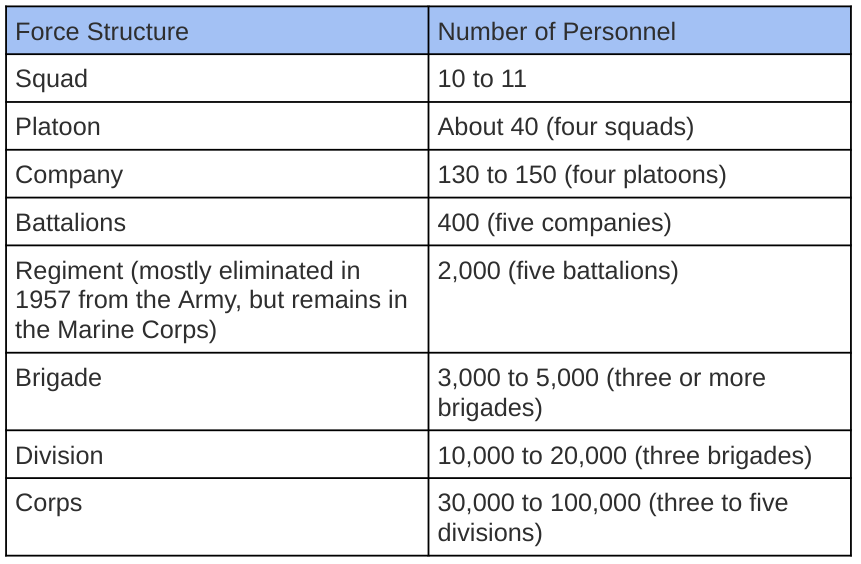
I was astonished to find that my original guess was in the right order:
– Platoon
– Company
– Battalion
– Regiment
– Division
As you can see I missed a few, but I’ll give myself some points for the sequence!
Oh, and I was also right about a squadron. It’s used for aircraft in the Air Force, the Navy, and the Marine Corps. In the Air Force it consists of anywhere from 30 to 500 personnel and 18 to 24 aircraft.
I know when the war of 1812 was fought, but I can’t tell you who the combatants were or what they were fighting about. I don’t know what the Boer Wars were about, how to pronounce Boer, or whether any boxers were actually part of the Boxer Rebellion. I don’t know if the Vikings fought the Visigoths, if the Mongols invaded the Huns, or whether any of them lived in remotely the same century. I can tell you the assassination of Archduke Ferdinand triggered World War I but I can’t tell you anything about him, including what country he was archduke of or what the title of archduke even means. I know the 100 Years’ War was between England and France but I can’t tell you in which 100 years, or even in which centuries, all that fighting took place.17The War of 1812 was actually fought from June 1812 to February 1815 and was between the United States and Great Britain. During the Napoleonic Wars, Great Britain implemented a naval blockade to choke off neutral trade with France. The U.S. felt this was illegal and contested it under international law. But what really triggered hostilities was the British practice of impressment, or forcing captured U.S. merchant sailors to fight for the British Royal Navy. The war was fought both in the U.S. and in Canada, and in both the Pacific and Atlantic oceans. The Treaty of Ghent ended the war on February 17, 1815. Find out more at this entry on Wikipedia.
18The Boer wars were fought from October 11, 1899 to May 31, 1902 between Great Britain and two Afrikaner (or South African) republics: the South African Republic and the Orange Free State. The war was fought over control over the South Africa republics. Great Britain believed they had suzerainty (which Merriam-Webster defines as overlordship) over South Africa and, in particular, over a rich gold-mining complex called Witwatersrand. The Peace of Vereeniging in May 1902 marked the end of the wars and independence for the South African republics, as Great Britain won the overlordship they were hoping for.19A Boer is a South African of Dutch, German, or Huguenot descent and it is pronounced either “BOW-er” or, in America, “BOOR.”20According to Wikipedia, the Boxer Rebellion was an “anti-foreign, anti-colonial, and anti-Christian uprising that took place in China between 1899 and 1901, toward the end of the Qing dynasty. They were motivated by proto-nationalist sentiments and by opposition to Western colonialism and the Christian missionary activity that was associated with it.” And regarding what I thought was a silly question about whether actual boxers took part, the answer is actually YES!: “It was initiated by the Militia United in Righteousness, known in English as the Boxers, for many of their members had been practitioners of Chinese martial arts, also referred to in the west as Chinese Boxing.”
21The Vikings were Scandinavian seafarers who terrorized Europe in the late 8th to late 11th centuries. The Visigoths were part of a larger group called the Germanic peoples who spoke some form of Germanic language (note: the term Germanic here does not mean German. In fact, English is considered a Germanic language, as is Dutch and even Afrikaans. See this entry on Wikipedia for more on Germanic languages). The Visigoths sacked Rome in 410 and maintained a presence in Europe until the 8th century A.D. I’ve found no evidence they ever fought each other. It looks to me like the Goths were headed home as the Vikings arrived at the bar.
22The Mongol empire existed in the 13th and 14th centuries. It originated from central Asia and grew to consist of parts of Eastern and Central Europe and even Siberia. The empire grew tremendously under its famous ruler Ghengis Khan and his descendants. The Huns lived in the same neighborhood (central Asia) but they lived about 700 years before Ghengis and his crew, between the 4th and 6th centuries, A.D. So the short answer is the Mongols never invaded the Huns.
23

Archduke Franz Ferdinand Carl Ludwig Joseph Maria was the archduke of Austria-Hungary and the next in line to the throne (and title of Emperor) of Austria-Hungary from the time of his father’s death in 1896 until his own assassination in 1914. His death was important, which we’ll get to in a second.
But first let’s talk about Austria-Hungary. What does that really mean? Austria-Hungary (also called the Austro-Hungarian Empire) came into existence in 1867 as part of the Austro-Hungarian Compromise. It brought the two nations together under one emperor and lasted until its dissolution in 1918 at the end of World War I. At the beginning of the war the Austro-Hungarian empire included the modern day countries of Austria, Hungary, Czech Republic, Slovakia, Bosnia and Herzegovina, Croatia, Slovenia, and parts of Italy, Poland, Ukraine, and Romania.
So how, then, did this one guy’s assassination lead to WWI? The short version is that Ferdinand was in Sarajevo to inspect the Bosnia and Herzegovina imperial armed forces following that country’s annexation by Austria-Hungary six years earlier. Serbian nationalists who felt Bosnia should actually be part of Serbia were angered by the annexation. They took advantage of his trip and while his motorcade had stalled trying to turn around, a Serbian named Gavrilo Princip shot his wife Sophie in the abdomen and Ferdinand in the neck.
History.com explains how this led to WWI: “The assassination set off a rapid chain of events, as Austria-Hungary immediately blamed the Serbian government for the attack. As large and powerful Russia supported Serbia, Austria asked for assurances that Germany would step in on its side against Russia and its allies, including France and possibly Great Britain. On July 28, Austria-Hungary declared war on Serbia, and the fragile peace between Europe’s great powers collapsed, beginning the devastating conflict now known as the First World War.”24The Hundred Years’ War ran from May 24, 1337 to October 19, 1453 making it more accurately The 116 Years’ War.
I don’t know how to get around using cardinal directions (yes, that’s what Wikipedia just told me they’re called) like north, south, east, and west. You may as well give me GPS coordinates and tell me to do some math in my head. My wife will sometimes tell me when we’re driving somewhere to “head West at the next block.” I usually give her a WTF look like she’s a lunatic for thinking that makes any sense. I’m equally likely to turn East as West because they both mean NOTHING to me. And yes, I know the sun sets in the west. But try using that trick at lunchtime while you’re driving around in a distinctly non-convertible minivan. Turn right? Now we’re talking. Rights and lefts make sense. It takes me a full five seconds to tell you which intermediate direction (that’s a combo one like Southwest) Texas is in relation to Oregon. I just don’t have that directional gene. If I ever go down in plane with you and we miraculously walk away unharmed, only to find ourselves in the middle of a forest with no idea where to go and a critical need to trust our internal compasses and each other, you should at no time defer to my compass as it will surely lead us to the mean bear from The Revenant.25I found this fabulous set of methods at wikiHow.com for finding your way, whether at night or during the day, and in either hemisphere or at the equator. The trick with the analog watch is pretty sweet and I tested it several times to validate it. It even works at Noon where I live because, as I found out, in the continental United States the Sun is NEVER directly overhead. I know many people reading this will think I’m such a tool for not really getting that until now. I honestly just never paid attention. A few years ago my wife told me the sun is lower in the winter, and I understood why when she explained it. But I didn’t know that meant it’s never totally above my head and hasn’t been in my entire life lived within the United States. Where I live in Redwood City, California, the absolute highest the Sun ever gets is 76 degrees on the Summer Solstice (if the Sun was absolutely directly overhead that number would be a pure right angle of 90 degrees). On Winter Solstice it gets as low as 29.1 degrees above the horizon. Hawaii is the only portion of the United States that falls between the Tropic of Cancer (23.5 degrees North of the equator) and the Tropic of Capricorn (23.5 degrees South of the equator) and thus the only state in the U.S. where the Sun is exactly 90 degrees overhead two times per year. The area between those two latitudes is referred to as the tropics, the tropic zone, or the torrid zone.

I will note, however, that I still can’t find anything that tells me how I can immediately find (without waiting for shadows to change over a 15 minute period) a particular direction with the Sun straight overhead at 90 degrees.
Here is a cool site that lets you plug in locations to find out when and where the Sun will be directly overhead (and all sorts of other stuff like sunrise, sunset, and solar noon – the time at which the sun is furthest overhead, even if it’s not 90 degrees).

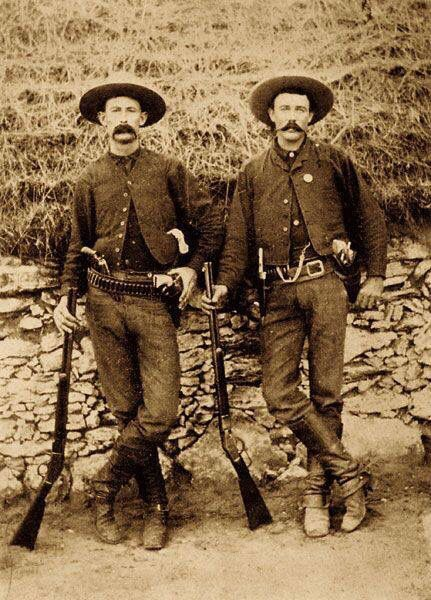
The other day at a stoplight one of my girls asked me if the car next to us was a cop car. I nervously glanced over, partly because cops, border guards, and pretty much all law enforcement professionals make me nervous even though I’m about as squeaky clean as a person can be, and partly because I was halfway through typing a message to my boss (because texting at a stoplight is not really texting and driving, right?). After my furtive glance, I told her it was a sheriff. She asked me how that was different than the police. Uh… I have a vague idea that in 2018 county jails are run by the sheriff and that in 1880 the sheriff was the badass law man in town with the handlebar mustache and the pointy gold-star pin. But then why, I thought, is the 2018 guy driving around if he’s supposed to be back at the jail preventing riots and escapes?26Sheriff and police departments generally are different in that the sheriff is usually elected, typically has county jurisdiction, and often runs the county jails and security for the courts. Specific responsibilities vary county by county quite a bit. If you have a desperate need to know what each state expects from their sheriffs, you can get a detailed breakdown at Wikipedia.
And finally, I am the worst with mealtime etiquette. I would have been thrown out of one of Lord and Lady Grantham’s weeknight dinners in under five minutes. When I’m at a friend’s house for a meal and everyone is offering help at various tasks, I’m always a little embarrassed when I end up setting the table. I’m pretty sure the fork goes solo on one side of the plate but I don’t know which side that is. And I think I remember being taught that you use your fork with your left hand to brace your meat, then do the cutting with the knife in your right hand. Then, inexplicably and completely inefficiently, you’re supposed to switch hands with the fork before you skewer and transport the bite to your mouth. What the heck is that awkward little choreography about? And how is that better manners than just using my left hand to bring it home? I’m also flummoxed by the napkin. At my house I typically don’t even remember to use napkins, let alone look up the proper placement. I’m used to eating dinner in about two and a half minutes between blood curdling screams and dodge ball with ketchup soaked chicken nuggets. If I do use one it’s usually a paper towel, often one of the cleaner ones left over from my kids’ lunch several hours before. So I just don’t know: for a group dinner, do you put it under the silverware on the right side, under the silverware on the left side, or place it somewhere in the middle on the plate? I guess a cute little tent on the plate sort of works, but it feels like a total cop out. I feel like the hosts are surely giggling over my ignorance and the amateur move meant to prove my proficiency. And back to the speed thing: I eat so fast now that even when I slow myself down to what feels like old lady pace, I still look up halfway through the meal and realize most people have only nibbled at their salad. My salad has vanished and I’ve killed half my pasta. I think I need more wine.27There are different place settings depending on the level of formality of the occasion. For a basic (less formal) place setting that would work for the situation I described, check out this great article from emilypost.com. They offer up an acronym that tells you quickly how to configure a place setting: FOrKS. It tells you, going from left to right, to start with the Fork, then move to the plate (“O” shape), followed by Knife, then Spoon (you skip the R). The napkin goes on the plate.

At this point you’re either laughing because you’re thinking about your own gaps in knowledge or you’re wondering how I’m not jobless and lamenting the fact that I’m passing this impressive brain power on to four more humans. You may also be wondering what my conclusion is to all of this.

As you can see from the highly scientific and rigorous generational study I conducted, my knowledge curve has already begun to bisect my daughters’ curves. I have to confront the truth that as I get older, more and more factoids will slip away. This used to bother me. When I was younger and I felt like I didn’t have a solid grasp of world politics, I subscribed to The Economist. I’d read it cover to to cover every week. I thought it would make me a more informed person and, subsequently, more able to engage in thoughtful dialogue about geopolitical issues of the day. For awhile my plan worked and I was pretty well informed. I knew what was happening in Zimbabwe’s fight for control of the country and how it was dramatically affecting the economy. I was up on the crisis in Darfur and could explain who the Janjaweed were, why they were aligned with the government, and why they were fighting rebels like the Sudanese Liberation Movement. I understood the intricacies of NAFTA, the purpose of ASEAN, and the differences between the United Nations and NATO.
But at some point I got busier and my time to study this stuff evaporated. Reading these articles and journals felt much more like work than it used to and my interest waned. Since then I’ve realized my mind is not a steel trap. I do not remember details with machine like accuracy and I cannot recall facts and figures like IBM’s Watson. Even in areas where I am passionate, I still can’t remember the details (example: I can’t tell you who won The Masters this year, even though I watched about 20 hours of coverage)28Patrick Reed won the 2018 Masters tournament.
My grand conclusion is…
…wait for it…
It doesn’t matter.
I simply don’t need all that data. Would it be cool to be able to quote Ghandi off the cuff as I teach my daughter about turning the other cheek? Or to explain to her what a covalent bond is while she does her ninth grade chemistry homework? Sure. That would be neat and I’d feel like a real life Will Hunting. But I can’t get that done.
So instead, I’ll focus on what I CAN do: I’ll teach them how to be good humans. Google is here to stay so I don’t need to know when Leonardo da Vinci painted the Mona Lisa or how to calculate the volume of a sphere. But I do need to teach my kids to accept themselves in all their flaws, to always live with integrity, to make mistakes in search of bettering themselves, and to love and be loved. I need to teach them how to manage anxiety and stress in search of a rewarding but balanced life. I will show them how to have difficult conversations to better their relationships. I need to teach them about making and keeping commitments, how to make hard choices with integrity, and how to adapt to the circumstances life throws at them. I also must teach them to persevere and that suffering is part of life – a part that you must experience and manage if you are to ever feel successful. I will introduce them to some of my favorite art, literature, and music (strangely, they don’t like “Creeping Death” yet but I know James Hetfield will grow on them). I will take them to our family’s most beloved places – like Yosemite, Hawaii, and, next summer, Italy – so they can gain valuable lessons through exposure to different scenery and cultures. And I will save all the money I can so they can go to college and learn more facts and lessons I am ill equipped to give them.
I will still answer my kids’ questions the best I can, but I will increasingly and unashamedly find myself leaning on the wisdom of Jeff Spicoli and Mr. Hand: “I. Don’t. Know.” I’ve read that Benjamin Franklin once said, “The doorstep to the temple of wisdom is a knowledge of our own ignorance.” If this is true, I’m one step away from greatness.
You are amazing, Gen. What a great article. I read it out loud to my husband. We both laughed and enjoyed it immensely. You are such a great person. I miss you! Keep teaching those kids. They are very, very lucky! Hugs, Jeanne
Aww, thanks so much Jeanne! I appreciate you reading it and your very sweet words of encouragement. Hope you’re doing great!
Hey… To make it easier on yourself, give your kids a question quota; for example, one question per year. Ha! Great article Genio. I do hope you and yours are doing well.
Mr. Alcantra! So glad to hear from you, and thanks so much for reading. I’ll try that question quota, though I’m guessing my success will be limited. Hope you’re doing great, my friend!
Genio – this post made me breathe a sigh of relief. As a dad raising a single 7 yr old boy, who often is stumped at many of the same questions, its nice to see that I am not alone!
I’m sure you’re doing great. As you read, I’m learning that my street smarts are much more valuable than my book knowledge. Thanks so much for reading! And good luck with that 7-year old.